
The ceasefire is still technically holding, to the extent that no overt hostilities have been reported yet, but the rhetoric has hardened dangerously. The week ahead will also clarify whether the Islamabad failure was a negotiating tactic or whether Washington has genuinely locked itself into a position from which the only exits are climb-down, escalation, or the slow bleed of a new status quo that nobody chose and nobody controls. Prem Panicker continues his must read blog on the Iran War.

Uncertainty surrounds the planned second round of peace talks between the US and Iran in Islamabad, as both sides engage in brinkmanship. Despite Pakistan's security preparations, Iran has yet to confirm its attendance, citing a lack of seriousness from the US in pursuing diplomacy and violations of the ceasefire.

US President Donald Trump is inclined to reject Iran's latest diplomatic proposal, which suggests restoring maritime traffic through the Strait of Hormuz while deferring nuclear programme concerns, according to CNN. Concerns remain over Iran's nuclear enrichment and internal government fractures.

The United States and Iran could resume negotiations as early as next week in Islamabad, according to a report by The Wall Street Journal citing people familiar with the matter.
Iranian Deputy Foreign Minister Kazem Gharibabadi has urged India to take the lead in bringing peace to West Asia, highlighting the UAE's role in stalling BRICS consensus on the conflict. Gharibabadi also discussed a new framework with Oman for merchant vessels passing through the Strait of Hormuz.
US President Donald Trump on Monday confirmed that a high-level American negotiating team, including Vice President JD Vance, Jared Kushner, and Special Envoy Steve Witkoff, is en route to Pakistan to initiate critical negotiations with the Iranian leadership.

Iran has denied agreeing to participate in a second round of peace talks, contradicting claims made by the United States. The denial comes as tensions remain high in West Asia, with a ceasefire window nearing its end.

US Vice President J D Vance is expected to travel to Islamabad for peace talks with Iran to end the seven-week war, amid a fragile ceasefire and ongoing tensions.

India has strongly protested a US military strike on the commercial vessel Settebello off the Oman coast, which left three of the 24 Indian crew members missing. The US Central Command stated it disabled the Palau-flagged vessel for violating a blockade of Iranian ports.

Iran has announced the Strait of Hormuz is open to commercial vessels, coinciding with a ceasefire between Lebanon and Israel.

...reopen for up to six months. Until then, the Strait stays nearly closed. The world pays. And no one, including the man who started this, can say when it ends, notes Prem Panicker in his must read blog on the Iran War.

Iran blames the US for 'maximalism' and 'shifting goalposts' leading to the collapse of the Islamabad talks.

Uncertainty surrounds the US-Iran talks as a two-week ceasefire approaches its end. Pakistan is attempting to mediate, but tensions remain high after a recent naval incident.

Ahead of the expiry on Tuesday of the two-week ceasefire declared by US President Donald Trump in the conflict with Iran, US media outlets reported on Sunday that negotiators Steve Witkoff, special envoy for peace missions and Jared Kushner will head to Islamabad for talks with Iran.

Sagiv Steinberg, CEO of the Jerusalem Center for Security and Foreign Affairs (JCFA), described the recent US-Iran peace agreement as a temporary 60-day ceasefire, not a genuine peace deal, suggesting it's timed for the upcoming US midterm elections.
US Vice President JD Vance is set to arrive in Islamabad on Monday evening to lead a high-level American delegation in a second round of ceasefire negotiations with Iran, CNN reported, citing White House on Sunday.

Indian benchmark indices, Sensex and Nifty, rallied significantly following a sharp decline in crude oil prices. This decline was triggered by US President Donald Trump's announcement of progress in negotiations with Iran towards a peace agreement, which led to renewed optimism in global markets.

US President Donald Trump is set to visit China for talks with President Xi Jinping on trade, global issues, and the Gulf war. The visit aims to address trade frictions and other key issues, with high expectations for progress.

Speaking to reporters aboard Air Force One, Trump said the US prefers a negotiated settlement and expects cooperation from Iran on securing nuclear-related materials.

Union Shipping Minister Sarbananda Sonowal confirmed the deaths of three Indian seafarers who were initially reported missing from the Palau-flagged MT Settebello. India has protested to the US over the attack on the commercial vessel, which the US Central Command stated was due to the vessel attempting to transport oil from Iran, violating a blockade.

Equity benchmark indices Sensex and Nifty tumbled in early trade on Monday, with the 30-share BSE Sensex falling 1,613.09 points and the 50-share NSE Nifty plunging 495 points, as the failure of US-Iran negotiations heightened concerns of a prolonged conflict driving crude oil prices sharply higher. Track Sensex, Nifty50 movement and key market drivers for April 13, 2026.

Despite disagreements over nuclear ambitions, recent US-Iran peace talks led by Vice President JD Vance have fostered crucial goodwill and a deeper understanding between the two nations, potentially paving the way for future negotiations.

External Affairs Minister S Jaishankar has emphasised India's commitment to safe maritime transit and condemned attacks on merchant shipping amidst the ongoing West Asia conflict and global energy market disruptions.

Chinese President Xi Jinping has called for the Strait of Hormuz to remain open for normal passage of ships, describing it as an 'international waterway' amid rising tensions between the US and Iran.
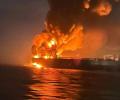
An oil tanker carrying 24 Indian seafarers reported a fire off the coast of Oman, with all crew members confirmed safe. The incident occurred amidst renewed hostilities between Israel and Iran, who exchanged attacks on petrochemical facilities.

Donald Trump has expressed confidence that Tehran will engage in diplomatic talks, warning that the country will 'see problems' should it refuse to cooperate.

The question is whether the clocks allow enough time for two deeply mistrustful sides to get there, and whether the surface calm holds long enough for the paddling to produce something before the ceasefire ends on April 22, notes Prem Panicker in his must read blog on the Iran War.

US Special Envoy Steve Witkoff and Iranian Foreign Minister Abbas Araghchi are reportedly heading to Switzerland for a new round of US-Iran negotiations, following a recently announced memorandum of understanding to end hostilities in West Asia and a ceasefire between Israel and Hezbollah.

Representative of Iran's Supreme Leader in India, Abdul Majid Hakeem Ilahi, expressed doubts about the United States' intentions regarding negotiations, citing conflicting actions and a desire to force Iran into accepting US demands.

US President Donald Trump maintains that the ceasefire with Iran is still in effect despite recent military engagements near the Strait of Hormuz. He also commented on a recent clash where US forces responded to Iranian attacks on US Navy destroyers.

US Marines boarded and searched a commercial ship, M/V Blue Star III, in the Arabian Sea on suspicion of violating the US blockade of Iranian ports, later releasing it after confirming it was not headed to Iran.

The Iranian Foreign Ministry has stated that Tehran currently has no plans for a subsequent round of negotiations with the United States, according to the state media Tasnim news agency. This announcement comes as international mediators had hoped for a follow-up to the Islamabad talks before the looming ceasefire deadline.

US President Donald Trump on Tuesday claimed that Iran is in a "state of collapse" and has requested the United States to help "open" the Strait of Hormuz.

Despite a ceasefire agreement between Iran and the United States, the Strait of Hormuz remains blocked due to Iran's inability to locate and remove all the mines it laid during the conflict, hindering global oil and gas supplies.

US President Donald Trump threatened to bomb Iran if a deal is not reached before the ceasefire ends, while Pakistan urged both sides to extend the truce and pursue diplomacy.
The United States has clarified that its naval blockade in West Asia targets Iranian ports and coastline, not the Strait of Hormuz, applying to all ships regardless of nationality. US officials warned Iran against threatening commercial ships and hinted at ceasefire negotiations as an alternative.

Iran has submitted its latest proposal aimed at advancing negotiations to end the ongoing West Asia conflict with the US, days after the Islamic Republic submitted a fresh proposal through regional intermediaries to cease its military operations in the Strait of Hormuz, which is likely to get rejected by Washington.

An Iranian delegation, led by Foreign Minister Abbas Araghchi, is expected to arrive in Islamabad for the second round of peace talks with the US, according to Pakistani media reports. This follows a phone call between Deputy Prime Minister Ishaq Dar and Araghchi regarding the US-Iran ceasefire and Pakistan's diplomatic efforts.

Trump has said he would be present at the signing ceremony in Islamabad. Don't be surprised if the Pakistani hosts make it a grand event in the geopolitics of the region. Trump would love that, notes Ambassador M K Bhadrakumar.
India's foreign policy establishment is adjusting with alacrity in real time -- an extraordinary spectacle in itself, considering the manifest reluctance to indulge in public diplomacy critical of American moves, observes Ambassador M K Bhadrakumar.
